Most commercial property appetite frameworks start as Word documents — a list of acceptable territories, a note about preferred construction classes, a few lines on TIV caps. The document circulates to producers, gets printed, gets annotated in the margins, and gradually diverges from how submissions are actually evaluated. By the time a new underwriter joins, the "appetite rules" exist in several conflicting versions and nowhere in the policy system.
Building a structured appetite model changes that — but the structure has to reflect how commercial property risk actually works, not just how a spreadsheet happens to be organized. This piece walks through the key dimensions of a commercial property appetite matrix and how to configure them in a way producers and underwriters can both work with.
Start With ISO Class Codes, Not General Categories
The most common mistake in appetite matrix design is working at too high a level. "Retail" is not an appetite class. ISO Commercial Lines Manual class codes — the five-digit codes that drive rating in most bureau-filed commercial property programs — are. ISO code 68500 (Retail Stores) covers a very different risk profile than 68506 (Jewelry Stores) or 68554 (Pawnbrokers). Grouping them into a single appetite bucket produces inconsistent screening: submissions that look acceptable at the category level get quoted when they shouldn't, and producers get a mixed signal about where the appetite actually sits.
A working appetite matrix for commercial property should be structured at the ISO class code level, or at minimum at the ISO Symbol level for BOP-eligible risks. That means mapping your historical loss data and current reinsurance treaty constraints against specific codes, not categories. Treaty structures matter here: if your per-risk facultative program has specific SIC or ISO code exclusions, those exclusions should be directly reflected in the appetite matrix, not left to underwriter memory.
For carriers with broader commercial property portfolios, NAICS codes provide a parallel reference. Many submissions will include both, and the appetite matrix should handle the mapping — either through direct NAICS-to-ISO crosswalk or through a field that captures whichever code the ACORD 140 submission provides.
TIV Bands and Construction Class Overlays
Total Insured Value is typically the first filter in a commercial property triage — below a minimum TIV, the account may not be economic; above a maximum, it exceeds per-risk retention authority or requires facultative placement that the underwriting team isn't set up to handle. The appetite matrix should express TIV bands as explicit thresholds, not as vague guidance ("large risks require SVP approval").
Construction class compounds TIV significantly. ISO construction codes 1 through 6 — Frame, Joisted Masonry, Non-Combustible, Masonry Non-Combustible, Modified Fire Resistive, Fire Resistive — carry very different loss cost profiles, and the interaction between construction class and occupancy drives both frequency and severity. A TIV band that's acceptable for a Fire Resistive office building may be well outside appetite for a Frame-constructed warehouse storing flammable materials. The matrix needs to express these interactions, not treat TIV and construction as independent variables.
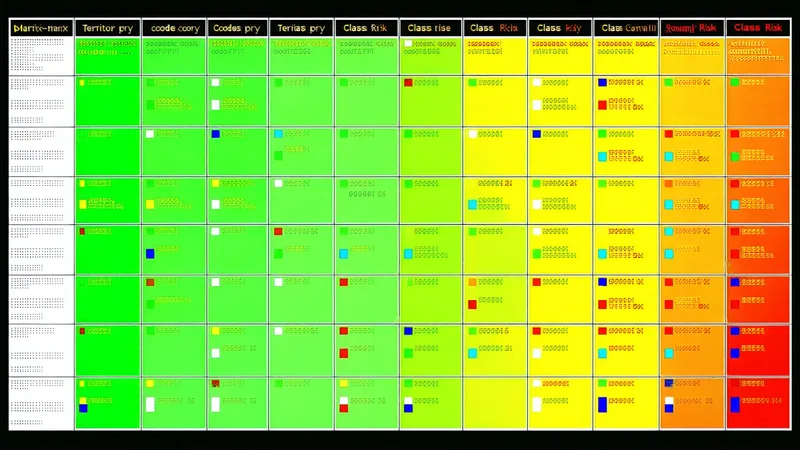
In practice, this means building appetite cells that combine both dimensions: construction class on one axis, TIV band on the other, with appetite status (in-appetite / borderline / out-of-appetite) in the cell. That's the structure ISO PolicyServices data and bureau rate filings assume — and it's the structure that makes appetite visible to producers in a way they can actually apply at submission time.
Territory Rules and CAT Zone Overlays
Territory appetite in commercial property is two-layered: the ISO territory (used for rating) and the CAT zone (used for accumulation management). These don't always align, and treating them as equivalent produces appetite rules that undercount or overcount exposure depending on the zone.
Consider a Northeastern U.S. carrier with coastal exposure. ISO territory 001 (New York) includes both inland Manhattan high-rises and coastal Long Island locations. From a rating perspective they're the same territory, but from a CAT accumulation perspective — particularly for storm surge and wind — they're materially different. The appetite matrix should overlay CAT zone designations from the carrier's active CAT model (whether AIR Worldwide, Moody's RMS, or CoreLogic) on top of ISO territory, so a coastal location in ISO territory 001 triggers a different screening path than an inland location in the same ISO territory.
CAT zone overlays should be updated when the reinsurance treaty renews, not annually on a calendar basis. Treaty terms directly constrain aggregate capacity by zone; if the treaty tightens Florida wind capacity at the July 1 renewal, the appetite matrix should reflect that tightening for new submissions before the renewal date, not after the first loss event.
A Scenario: Appetite Matrix Calibration at a Mid-Atlantic Carrier
Consider a regional commercial property carrier writing primarily in the Mid-Atlantic and Northeast, with a treaty that capped total insured value aggregates for Frame construction in coastal Connecticut and Rhode Island counties following the 2023 storm season. The carrier's existing appetite documentation listed "coastal New England" as "refer" — a single rule that triggered manual review for every coastal submission regardless of construction class, TIV, or occupancy.
The result was predictable: underwriters spent significant time on submissions that were clearly within capacity (ISO code 52121, Frame-construction office buildings inland of the coastal zone, TIV under $2M) because the territory rule was too coarse. They also occasionally missed the specific Frame/coastal/TIV combination that actually stressed the treaty, because the one-line rule didn't differentiate.
Restructuring the matrix along construction class × TIV band × CAT zone reduced manual referrals on clearly acceptable submissions while flagging the specific combinations the treaty cared about. Auto-refer logic could be pointed at Frame construction in FIRM Zone AE with TIV over $1.5M; everything else in the same territory got screened on the normal class code rules. The change was visible and auditable — when the treaty terms changed at the following renewal, the appetite matrix update was a specific cell change, not a rewrite of a prose document.
Communicating Appetite to Producers
We're not saying that building a structured appetite matrix automatically solves the producer communication problem — it doesn't. A well-structured internal matrix that producers can't interpret is only half the solution. The other half is a producer-facing summary that translates the matrix logic into something actionable at submission time.
That summary doesn't need to expose every rule. Producers don't need to see the TIV × construction class matrix in full detail; they need to know, for the account they're about to submit, whether it's worth submitting at all. A structured appetite matrix makes it possible to generate a producer-facing appetite summary automatically — filtered by the producer's bound territory, the lines they're authorized to write, and the carrier's current hard-market posture — rather than maintaining a separate document that drifts from the real rules.
ACORD 140 completeness at submission is part of this loop. If a producer submits without a construction class, the appetite screen can't run accurately. The completeness check and the appetite check are connected: a matrix that requires construction class as an input creates a natural incentive for producers to complete that field.
Handling Hard-Market Appetite Tightening
In the current commercial property environment — consecutive years of rate hardening in coastal and CAT-exposed territories, reinsurance cost increases flowing through primary programs — appetite rules need to be adjustable without requiring a full matrix rebuild. The mechanism for this is an override layer: a set of tightening rules that can be applied on top of the base matrix when market conditions warrant.
Typical hard-market tightening overlays in commercial property include: raising TIV caps in CAT-exposed zones, narrowing acceptable construction classes (e.g., removing Frame-construction eligibility above a threshold TIV in specific territories), adding occupancy exclusions for habitational risks, and tightening business interruption limits relative to building value. These overlays should be versioned and dated — so the underwriting team can trace exactly when an appetite tightening took effect and what submissions were evaluated under which version of the rules.
Version control on appetite rules isn't just an operational nicety; it's directly relevant to underwriting audit and any subsequent actuarial review of whether the book was underwritten consistently with the stated appetite during a given policy period.
Practical Configuration Principles
A few principles that apply regardless of the specific appetite rules being configured:
First, every appetite rule should have a stated reason — reinsurance treaty constraint, loss history, regulatory limitation, or market posture decision. Rules without stated reasons tend to persist long after the reason disappears. Second, the matrix should distinguish between "out of appetite" (hard decline) and "borderline" (refer to senior underwriter) — conflating the two produces inconsistent outcomes and undercuts producer trust. Third, the appetite matrix review cycle should be tied to treaty renewals and loss reviews, not to a fixed annual calendar.
The investment in structured appetite configuration pays back at the submission intake stage, where the volume of off-appetite submissions directly affects the cost of underwriting. Every submission that clears the appetite screen automatically is a submission that a commercial underwriter doesn't spend 20 minutes reviewing before declining.
Perilarc supports ISO class code and territory-level appetite matrix configuration, with CAT zone overlays and versioned rule sets. If your team is working through a commercial property appetite reconfiguration, request a pilot review to see how the matrix tooling works with your specific lines and treaty structure.