For Commercial P&C Carriers
Give your VP Underwriting and Chief UW Officer a decision-grade tool that connects submission intake to appetite rules and ISO/Verisk data — without replacing your existing policy system.
What changes for your UW operations
Loss ratio improvement
Structured appetite enforcement at intake reduces adverse selection. Off-appetite submissions that previously reached underwriters are screened at the gate — reducing the proportion of submitted risks that don't match your pricing assumptions.
UW expense ratio reduction
Automating completeness checks, appetite screening, and risk score computation reduces the time UW operations spends on pre-triage. Underwriters spend their time on risks worth quoting — not on screening submissions that should never have been quoted.
Submission cycle time reduction
Auto-routing clean in-appetite submissions directly to the UW queue — without manual pre-triage — typically reduces average submission-to-decision time significantly. Producers get faster responses on in-appetite risks.
Perilarc across your commercial lines
Commercial Property underwriting
Commercial property is the highest-value and most data-intensive commercial line for appetite decisions. TIV, construction class, occupancy code, territory, and CAT zone exposure all interact — and decisions made at intake have direct impact on loss ratio and CAT accumulation exposure.
Perilarc's appetite matrix for commercial property handles ISO class codes, TIV bands, CAT Tier 1/2/3 overlays, and construction class filters. Verisk PropertyAnalytics and CoreLogic Property Data feed the risk score for each submission.
ACORD Forms Used
Commercial Auto underwriting
Commercial auto underwriting requires fleet composition, driver history, radius of operation, and cargo type — all extractable from ACORD 65 fields. Verisk PolicyAnalytics fleet risk signals and loss history from LexisNexis C.L.U.E. Commercial feed the scoring model.
Appetite rules for commercial auto can filter on fleet size, USDOT authorization, radius category, and cargo class — before the submission reaches a commercial auto underwriter.
ACORD Forms Used
General Liability underwriting
GL submissions contain more class code and operations detail than most carriers systematically use in appetite screening. ACORD 126 fields — operations description, premises type, payroll exposure, annual revenue — provide the raw data for structured GL appetite rules.
ISO GL class codes and loss-cost benchmarks from ISO PolicyServices integrate with Perilarc's GL appetite matrix to provide a structured pre-screen before manual underwriting review.
ACORD Forms Used
Workers Compensation underwriting
Workers compensation appetite rules depend heavily on NCCI class code, payroll exposure, experience modification factor (EMod), and jurisdiction. ACORD 130 fields provide the structured input for WC appetite screening and NCCI-based risk scoring.
Perilarc's WC appetite matrix supports NCCI class code rules, state jurisdiction filters, EMod threshold routing, and payroll-based TIV banding — configurable per WC book segment.
ACORD Forms Used
How Perilarc fits your carrier workflow
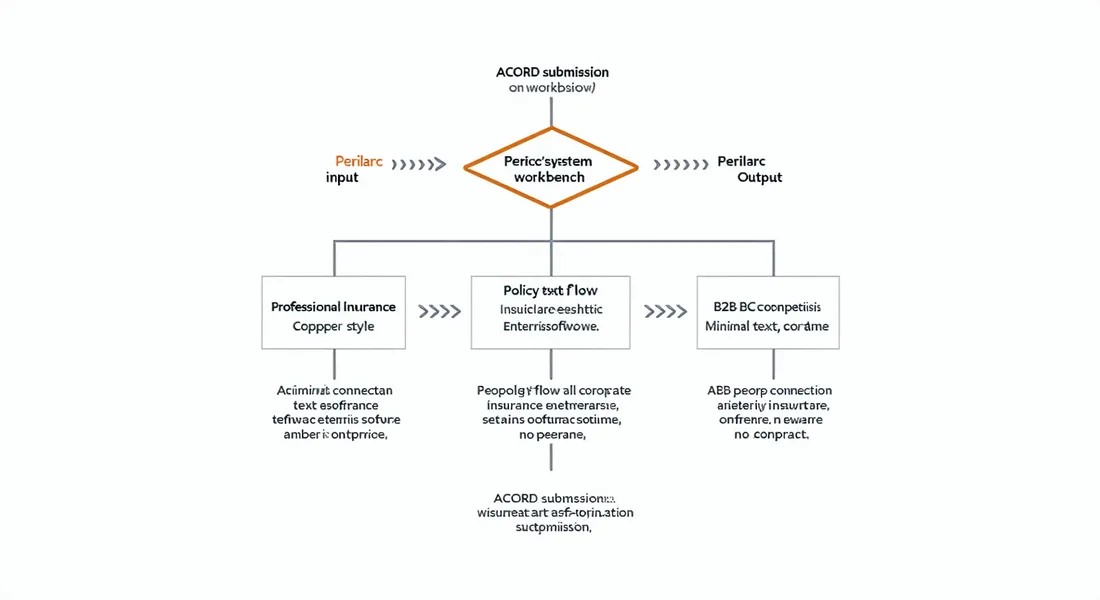
Perilarc sits between your ACORD submission intake channel and your Guidewire, Duck Creek, or Insurity policy system — adding the appetite screen and risk score layer without replacing your existing infrastructure.
Schedule a technical review for your carrier
We'll walk through your current submission workflow, lines of business, and policy system integration points. No generic demo — a structured review of your specific context.