The technology stack that a managing general agent actually operates on in 2026 is usually a layered accumulation of decisions made under time pressure. A binding authority from a new capacity provider required a specific policy admin system. A producer relationship needed a certificate management tool. Appetite guidance was being managed in a spreadsheet that's now three years old and maintained by one person. The aggregate result is a collection of systems that don't naturally talk to each other, and a gap where underwriting intelligence should sit.
This piece maps where MGAs actually are on technology adoption across the binding authority workflow — and where the gaps in the current landscape create both operational risk and competitive exposure.
The Core System Categories in an MGA Operation
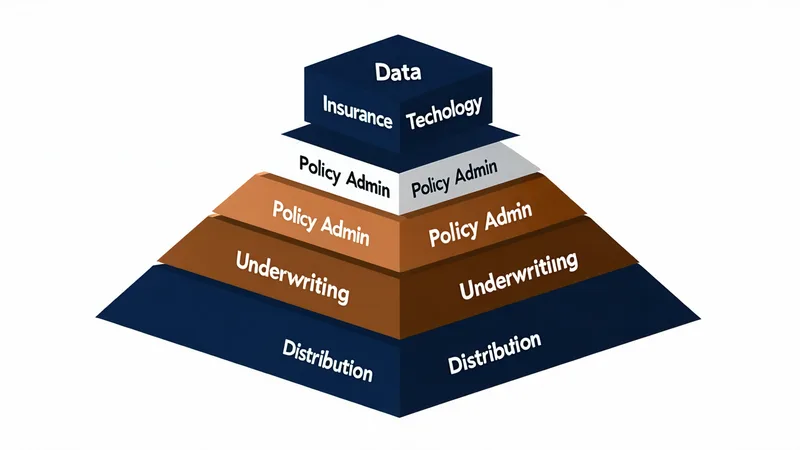
MGA technology stacks typically include components from four categories: policy administration, submission management, data and reporting, and appetite communication. The maturity level in each category varies enormously between a small specialty MGA writing $20M in premium and a multi-line operation approaching $150M.
Policy administration systems. MGAs with carrier-granted binding authority need a policy admin system that can issue policies, generate declarations, and manage endorsements. The options range from carrier-hosted systems (where the capacity provider provides a portal to issue onto their paper) to independent MGAs using platforms like Majesco PolicyMax, Insurity Policy, or custom-built issuance tools. Carrier-hosted portals are the most common for newer or smaller binding authorities — they require less upfront investment but give the MGA limited control over submission data capture and no independent view of their bound portfolio.
Submission intake and tracking. How an MGA receives, logs, and tracks submissions to quote-bind-decline outcome is where the largest variation exists. A segment of MGAs still manage this primarily through email and spreadsheet. More operationally mature MGAs use a CRM or submission tracking system — Salesforce Financial Services Cloud is common at larger operations, but standalone commercial lines CRMs also exist in this space. The gap is that most submission tracking systems were designed for deal tracking, not for underwriting workflow with appetite pre-screening.
Reporting and portfolio analytics. Delegated Underwriting Authority (DUA) reporting requires MGAs to provide regular production, binding, and loss reports to their capacity providers. The format and frequency of these reports vary by DUA agreement, but most require premium, exposure, and (eventually) loss data by line of business and territory. MGAs that issue on carrier-hosted portals often have limited independent access to this data — they depend on the carrier's reporting cycle, which is not always aligned with what the MGA needs for its own portfolio management.
The Appetite Communication Gap
One of the most consistent operational problems across MGA operations of all sizes is appetite communication to producers. An MGA's appetite is constrained by its binding authority agreements — each capacity provider has specific class, territory, TIV, and coverage restrictions, and the MGA can only bind within those parameters. Keeping producers current on what the appetite actually is, across potentially multiple capacity providers with different restrictions, is a continuous communication challenge.
The typical solution is a published appetite guide — a PDF or web page that lists acceptable classes, territories, and coverage parameters. The problem with appetite guides is that they're static: they reflect the appetite at the time they were written, not the current appetite after a carrier's restriction update or a mid-year capacity change. Producers who submitted off-appetite accounts in good faith, not knowing the restrictions had tightened, create operational overhead for the MGA's underwriting team and damage producer relationships.
A more operationally sound approach is to treat appetite as a live data set that producers can query at submission time, rather than a document they reference when writing up an account. This is where underwriting intelligence tooling fits into the MGA stack — not as a replacement for the policy admin system, but as the layer between submission intake and the policy system that applies current appetite rules to incoming submissions before they reach the underwriting queue.
Binding Authority Compliance and DUA Constraints
DUA (Delegated Underwriting Authority) agreements define exactly what an MGA can bind without prior carrier approval — by class, territory, coverage form, TIV, and sometimes by specific ISO class code or NAICS industry group. Operating within DUA constraints is both a compliance obligation and a practical business concern: a pattern of out-of-authority bindings is the fastest way to lose a capacity relationship.
Most MGAs rely on underwriter knowledge of the DUA constraints rather than systematic enforcement at the submission level. This works when the underwriting team is stable and the authority is narrow, but it breaks down as the team grows, as authority expands across more carriers, and as class code boundaries get more complex. The commercial auto DUA might restrict binding for trucking operations with radius over 500 miles; the commercial property DUA might cap TIV at $5M for wood-frame construction in specific ZIP codes. Keeping these constraints in underwriter memory rather than encoding them as system rules creates compliance risk.
We're not saying that every DUA constraint needs to be automated — some nuanced conditions genuinely require human judgment, and automating them incorrectly creates worse outcomes than leaving them to the underwriter. What we are saying is that the hard constraints — the specific class code exclusions, the TIV caps, the territory restrictions — are well-suited to automated enforcement, and leaving those to memory is an avoidable error vector.
A Scenario: Multi-Carrier Appetite Management at a Growing Commercial Lines MGA
Consider a commercial lines MGA in the Southeast writing commercial property, GL, and commercial auto on three carriers' paper, with binding authority agreements that have different class restrictions for each line and carrier. The MGA's underwriting team of six manages appetite guidance through a combination of internal reference documents, underwriter email distribution lists for carrier updates, and institutional knowledge built up over three years of operation.
A producer submits an account for a storage facility operator in coastal Georgia — commercial property TIV $2.2M, Frame construction, within 5 miles of the coast. Two of the three carriers have explicitly excluded Frame construction in coastal Georgia counties above $1.5M TIV following the prior year's wind season. One carrier remains open to it with a wind deductible endorsement. The submission routes to an underwriter who knows about one of the carrier restrictions but isn't current on the second, and quotes on a carrier that doesn't actually have capacity for this risk.
The bind attempt fails at the carrier portal. The producer gets a delay, the underwriter has to re-quote on the correct carrier with the correct terms, and the MGA's submission cycle time for that account stretches to several days. The root cause isn't underwriter error — it's that the appetite data wasn't available at the submission intake point.
What the Technology Gap Actually Costs
Technology gaps in MGA operations cost in two ways that don't always appear on the same P&L line. The first is direct operational overhead: time spent on off-appetite submissions, re-quoting after DUA errors, manual DUA reporting compilation, and carrier audit preparation. For a growing MGA processing several hundred submissions per month, this overhead is measurable in underwriter hours per month — time that could otherwise be spent on accounts that are actually bindable.
The second cost is competitive: MGAs that provide producers with faster responses on in-appetite risks, and clear early indication on off-appetite submissions, get better submission flow from quality producers. The producer's rational behavior is to send submissions where they expect a timely answer. An MGA with slow, unpredictable triage gets a lower share of the producer's best accounts.
Where Underwriting Intelligence Fits in the MGA Stack
Underwriting intelligence tooling in the MGA context isn't a replacement for the policy admin system — it sits upstream of it. The workflow is: submission arrives (via ACORD XML/AL3, email attachment, or producer portal) → intake and parsing → appetite pre-screen against current DUA-constrained rules → risk scoring → routing to queue or auto-response → underwriter action → bind in the policy system.
The value of a structured pre-screen is asymmetric. It takes seconds to run a submission through current appetite rules; it takes 20-45 minutes of underwriter time to evaluate an off-appetite submission and communicate the decline. At volume, the pre-screen's value compounds quickly, and the DUA compliance enforcement component reduces the carrier-relationship risk that comes from out-of-authority bindings.
The MGA tech stack in 2026 doesn't need to be rebuilt from scratch — the policy admin systems and producer portals that exist work well enough for what they were designed to do. The gap that's most worth closing is the appetite-and-triage layer: the logic between submission receipt and underwriter assignment that currently runs on institutional knowledge and spreadsheets.
Perilarc is designed for commercial lines MGAs managing binding authority operations — with configurable appetite matrix tooling that reflects DUA constraints per carrier and line. See the MGA-specific capabilities, or request a pilot review to discuss your current stack configuration.