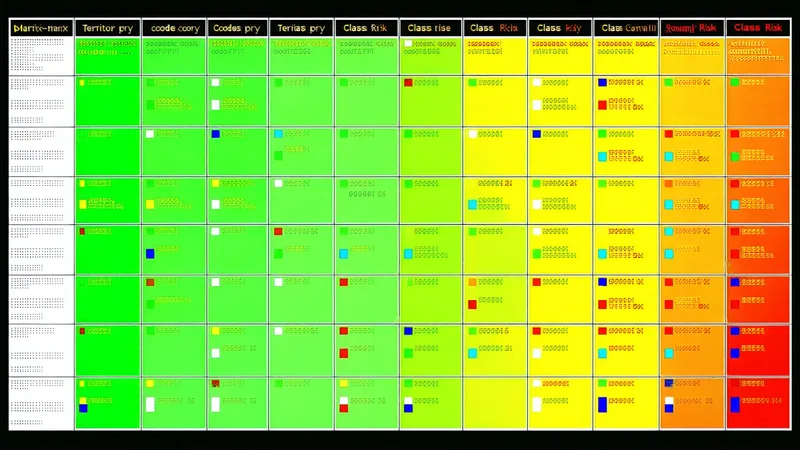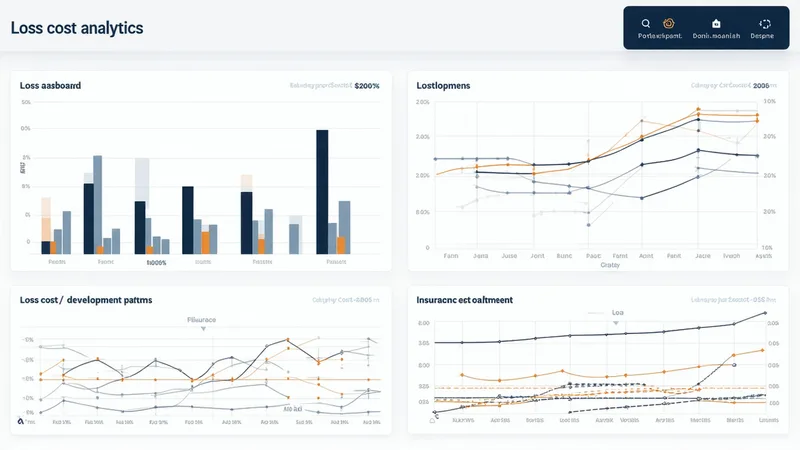
For commercial mid-market risks — accounts in the $250K to $5M TIV range, or GL risks with $500K to $5M in annual payroll or receipts — the external data environment is thinner than for large commercial accounts. Large commercial accounts attract formal actuarial rate development, specific underwriting studies, and sometimes facultative reinsurer input on complex risks. Mid-market commercial risks get rated primarily from ISO loss costs, experience modification for accounts that qualify, and underwriter judgment informed by loss history queries.
The challenge in mid-market commercial is building a pricing signal that differentiates within the ISO class code — that goes beyond the ISO benchmark to identify which specific accounts within an eligible class are likely to generate loss ratios above or below the class average. This piece describes how carriers can build that signal from their own submission history combined with ISO industry class benchmarks, without requiring a formal actuarial study for each individual account.
Why ISO Loss Costs Alone Are Insufficient for Mid-Market Pricing
ISO loss costs represent industry-average expected losses per unit of exposure for a specific class code, territory, and coverage component. They're developed from statewide and nationwide loss experience submitted to ISO's statistical plan by participating carriers. For any given carrier writing a specific class in a specific territory, the ISO loss cost may be a reasonable starting point, but it's an average — and the carrier's actual loss experience for accounts that look like the submission being priced may be materially different from the industry average.
ISO loss cost adequacy also depends on the carrier's ability to achieve rate levels consistent with the ISO loss cost. In bureau-filed states, carrier rates are filed as a deviation from ISO loss costs (or as independent rates), and the actual rate filed may be above or below ISO loss cost depending on market conditions and the carrier's competitive positioning. A carrier writing at ISO loss cost in a class where the market is generally below ISO loss cost is getting adverse selection — only the accounts that couldn't find cheaper coverage are submitting.
For mid-market commercial risks, the ISO loss cost deviation from the carrier's own experience in a class code segment is typically not tracked rigorously. Large account underwriting has formal loss picks and actuarial studies. ISO-rated small commercial accounts have standardized rates with limited deviation. Mid-market falls in between — individually assessed but without the formal analytical infrastructure of large accounts. That's where submission history analytics creates the most value.
Building a Loss Cost Signal From Submission History
The inputs for a carrier-specific mid-market loss cost signal are: submission history (including submissions that were quoted-and-declined, not just bound accounts), bound policy loss experience, and ISO class benchmarks for comparison. The goal is to identify, within each eligible ISO class code segment, which submission characteristics predict loss ratios above or below the class benchmark.
The predictive characteristics that typically emerge from mid-market commercial submission history analysis:
Years in operation relative to class average. Newer businesses (3 years or less) in most commercial classes have higher loss frequency than established operations. The ISO loss cost is an average that includes all account vintages. An appetite matrix that applies a pricing load to accounts with less than 3 years of operating history, within eligible classes, will generally outperform the ISO benchmark on an expected loss basis.
Prior carrier history and continuity. Accounts with continuous carrier history and no lapses in the past 3 years are better loss risks than accounts with recent lapses or frequent carrier changes. This signal is available from Verisk PolicyAnalytics prior carrier data at submission time and should be incorporated into mid-market pricing, not treated as an underwriting flag only for large accounts.
Operations description complexity relative to class code. Mid-market GL and commercial property accounts with complex multi-use operations (retail plus light manufacturing, professional services plus product sales) have higher within-class loss variability than single-use operations. The ACORD 125/126 operations description provides the text signal; a reasonableness check that flags operationally complex accounts for rate loading or senior review is a practical way to capture this within the submission triage workflow.
Location-level loss history from LexisNexis C.L.U.E. Commercial. For commercial property mid-market, the single best predictor of future loss frequency is prior loss history at the location — LexisNexis C.L.U.E. Commercial provides this signal for most commercial property locations. Accounts with prior losses at the specific location being submitted are systematically worse than the class benchmark, controlling for other factors.
A Scenario: Deriving a Pricing Signal for Mid-Market Commercial Property
Consider a regional carrier writing commercial property in the Northeast, with a book concentrated in light commercial accounts in the $500K to $3M TIV range across retail, professional services, and light industrial classes. The carrier has three years of submission and bound account data in its policy system, but hasn't built a systematic model from that history — individual underwriters use their own judgment informed by LexisNexis C.L.U.E. queries and ISO territory factors.
A structured analysis of the carrier's commercial property submission history reveals that within the two most common ISO class code segments (general retail at ISO 68500, professional office at ISO 68152), there are identifiable subgroups with materially different loss ratios: accounts with prior C.L.U.E. losses in the past three years have loss ratios approximately 30-40% above the class average in both segments; accounts with continuity of coverage for 5+ years and clean C.L.U.E. history have loss ratios approximately 20-25% below the class average.
These aren't surprising findings to an experienced commercial property underwriter — prior loss history and coverage continuity are known predictors. The value of building the pricing signal explicitly is that it quantifies the loading and credit to apply, makes the adjustment consistent across all accounts in the class rather than dependent on individual underwriter discretion, and creates an audit trail for actuarial review. When the carrier files rate adjustments with the DOI, the pricing signal analysis is the documentation that supports the deviation from ISO loss costs.
ISO Industry Class Benchmarks as a Calibration Reference
ISO publishes loss cost benchmarks by class code and territory, and also publishes industry class benchmarks that aggregate loss cost data across related class codes. These benchmarks — available through ISO PolicyServices — provide a reference point for calibrating the carrier's submission history signal against the industry-wide experience.
When the carrier's derived pricing signal produces loss ratio predictions for a class segment that are consistently above or below the ISO benchmark, the difference can be explained by three factors: superior or inferior risk selection within the class (the carrier is selecting better or worse than average), geographic concentration that differs from the ISO state average, or a sample size problem (not enough data in the carrier's history to produce a stable signal for that class segment).
The ISO benchmark calibration is particularly important for class code segments where the carrier's submission volume is thin — fewer than 50-100 bound accounts in the analysis period. Thin-data segments require borrowing from the ISO benchmark to stabilize the prediction, rather than relying solely on carrier history. A credibility-weighted blend (carrier experience weight proportional to exposure volume, ISO benchmark filling the remainder) is the actuarially appropriate approach and is consistent with the credibility methods in ISO's published statistical procedures.
Where the Mid-Market Signal Has Limits
We're not saying that a submission history-derived pricing signal replaces underwriting judgment for mid-market commercial risks — it doesn't, and it shouldn't. The signal is a starting point and a consistency tool, not a replacement for the risk-specific assessment that differentiates commercial underwriting from personal lines scoring.
The signal is most reliable for accounts that look like the historical training set — standard commercial class codes, single-state operations, no unusual coverage requirements. It's least reliable for: accounts at the edge of the class code (operations that are technically in-appetite but unusual for the class); accounts with unique risk management programs (fleet safety, sprinkler systems, security monitoring) that reduce loss cost in ways the submission data doesn't capture; and accounts where the ACORD submission data quality is poor (incomplete operations descriptions, unreported prior losses).
The appropriate use of a submission history pricing signal is to set initial pricing parameters automatically for accounts that score as standard within the signal's reliable range — and to route accounts that are unusual relative to the training data to underwriter judgment, not to attempt to extend the signal beyond its credible range.
Practical Implementation for Mid-Market Books
Building a mid-market loss cost signal from submission history doesn't require a large data science team or an actuarial study budget. The minimum viable analysis requires: a complete submission history extract from the policy system (including declined submissions, not just bound accounts), a join to loss experience data for bound accounts, and a set of credibility-weighted loss ratio calculations by ISO class code segment and key predictive variables.
That analysis can be run on a few hundred to a few thousand accounts and produce useful pricing guidance — more accounts produce more stable signals, but the qualitative findings about which predictive variables matter are often stable even with limited data. Carriers that build this analysis and update it annually, incorporating new loss development as policies mature, produce pricing signals that improve the loss ratio discipline of their mid-market book without requiring account-by-account actuarial analysis.
The integration point with the underwriting workbench is the pricing signal output: for a given ACORD 125/140 submission in an eligible class code, the system applies the carrier's credibility-weighted loss cost signal and presents the expected loss ratio relative to target, with the signal components visible to the underwriter. That output informs pricing, appetite decisions, and referral routing — without replacing the underwriter's judgment on the full account.
Perilarc's risk scoring methodology supports loss cost signal construction from submission history combined with ISO class benchmarks — designed for mid-market commercial books where external data signals are thinner than for large accounts. To see how this applies to your commercial lines portfolio, request a pilot review.